
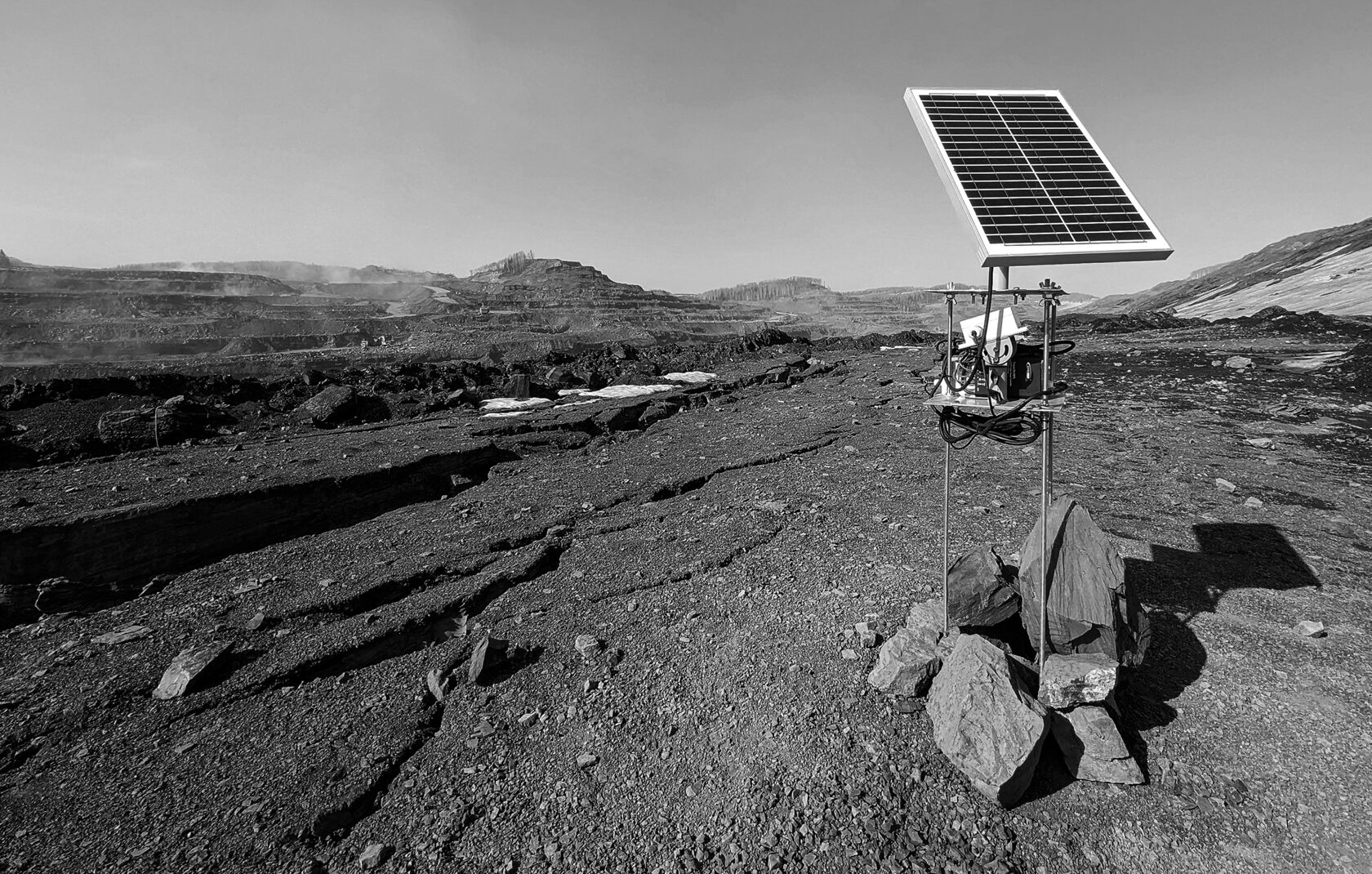
NUR Extensometer.
An instrument for automated displacement monitoring based on a laser distance sensor. It works by high-frequency measurement of the distance to a reflective surface and transfers the data to a server
Specifications
- Measurement range
- 0–40 m
- Measurement accuracy (RMS)
- 1 mm
- Resolution
- 1 mm
- Measurement frequency
- configurable, from 1 sec⁻¹
- Online displacement monitoring
- with ~1 s latency
- Data transfer
- via GSM (radio and other channels planned)
- Alerts
- via Telegram bot, SMS, e-mail
- Autonomous power supply
- 5 V
- Autonomy
- when connected to a solar panel
- Battery capacity
- 38900 mAh (144 Wh)
- Moisture and dust protection
- IP65
- Laser hazard class
- 2
Applications
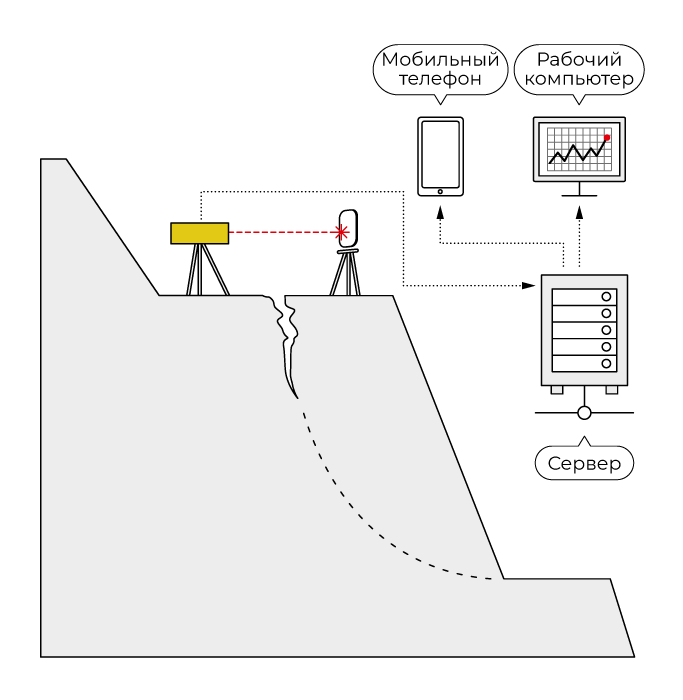
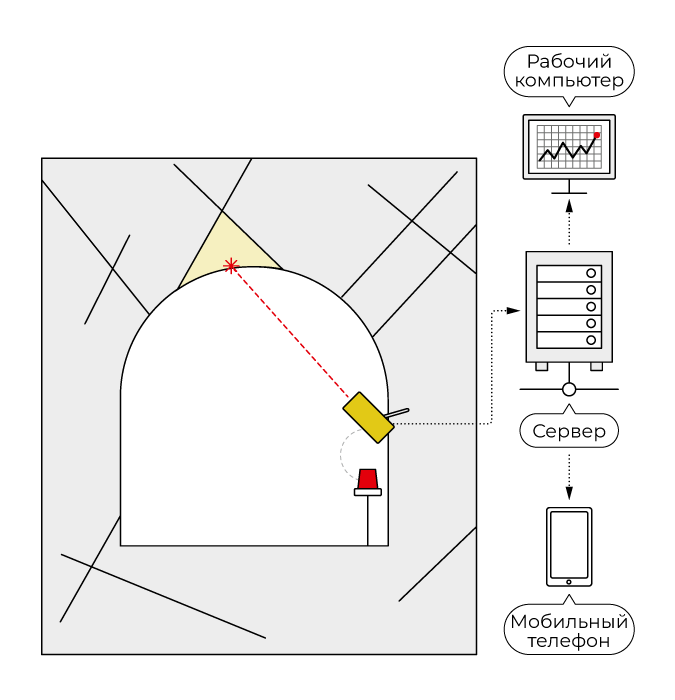
The NUR extensometer is designed for monitoring rock spalling, joint opening, convergence of underground openings, and failure control on open-pit slopes and in the walls and backs of underground openings.
The measurement accuracy is sufficient to capture displacements at early stages of failure. The high measurement frequency allows displacement velocities to be determined, making it possible to predict the time of failure and issue alerts when critical velocities are reached (similar to interferometric radars).
To date, the instrument has been tested in open pits, where it proved effective. Testing in underground openings has not yet been carried out.
Installation
- The instrument is mounted on a special bracket that provides fixation and 360° rotation
- A solar panel is connected for continuous, fully automated operation
Monitoring
Extensometer measurements are displayed as charts in our web service. The web service shows distances, displacement velocities and more in real time. Alerts for exceeding critical velocities are configurable.
